

Character Booklet Template
Download the template and listen/read the adventure in making it

I recorded the audio first, thinking I could easily add in the visual elements later. Nope, not easy. Instead of spending oodles of time trying to make things perfect, when the visual parts aren’t needed, you get beautiful nature videos from Joey Bania’s Abstract Earth collection on Death to Stock.
You’ll find the PDF template and printing instructions below the post.
Listen/watch
Read
Below is a lightly edited transcript of the audio (lightly edited means I corrected a few words I messed up in the video. Fixing text is a heck of a lot easier than fixing audio).
TADA! We have the character booklet!
I put this together because I was struggling so hard with the characters and keeping track of them and their little phrases and what they're doing and their motivations and all of those pieces. And I don't like hitting walls. I'm just going to say that right now. I don't like hitting walls. And so I tried a lot of things and I came up with a character booklet. So I'm going to take you through how I actually got here. I actually think it's a fun little adventure. And then you can download the character booklet template as well, so you can use that for yourself in case it's helpful. Alright, so let's get started.
This is way informal in case you couldn't figure that out. I'll probably do a lot of editing with this. (Side note, I didn’t edit anything). But I wanted to take you through how the struggle with characters are quite real. You have them in your brain. I understood these folks, but as you're writing…look, you all know…lemme start again. You all know how hard it is to write characters so that they're realistic, they're relatable, and they actually have that human element to them. So they've got their foibles, their little phrases, their little mannerisms, all of that. And while it's perfectly captured in your brain, your brain is also a squirrel and buries nuts and then forgets where the hell they actually buried them. That's kind of how it was with me with trying to create these characters and keeping track of those little nuts and seeds that I buried and find them again.
So with my squirrel brain, I said I got to do something. So initially what I did is I used every template that I could find that was out there. I used Reedsy’s template that they had for creating characters. I used Scrivener's template for creating characters. Again, where everything is written out, you can type it all out, all this kind of stuff. And it's very structured. So I'm like, all right, this works. But it's so isolated and siloed from my writing because I would have to switch tabs or I would have to go to something else, or even before I had written out all of this in-depth information about characters for a previous book, and it was in a folder, but I would have to open the folder, flip through the pages, try and dig it out. It was not clicking for me.
In my other life, I also do work a lot with spreadsheets. So I'm like, all right, lemme put it into a spreadsheet. Then at least rows and columns, they make sense to my brain. So I built a row and column spreadsheet for each of the four main characters. Initially I had them all on a single page. Each one was a column, and then I had the different rows. So at least I could kind of keep the same things and compare and contrast the differences. See if I had anybody that felt a little bit meh as compared to the others. Alright, so I had that. Then it became too overwhelming because as you can imagine, once you, and you see here, once you get the characters, their images in there, those take up a lot of space and I couldn't quite see everything all together. So even though my intent was to see everything altogether, I still couldn't do it. So I split 'em into their different tabs. Good, but again, separated and isolated.
Again, I'm hitting walls. I don't like hitting walls, and I certainly don't give up when the walls keep presenting to themselves to me. So I said, screw this. What else is here?
In another part of my life, I do a lot of role-playing, Dungeons and Dragons type gaming. And I remember the D&D game or character sheets that they had, and they had all these different sections and it was visually appealing. So you had, here's your character sketch. Here are the key skills that they have, here’s what’s in their inventory. And there were these nice little boxes and it was artistic enough that you could kind of feel it. And there was something about writing it in pencil and keeping track of it as you go through that. I thought, ah, got it, I'm ready to go. I think this might work. So I gave it a shot.
I put together a character sheet for the different characters using artistic stuff. I was like, let's just make this look at least somewhat interesting. And I left the boxes blank so I could, if you will, fill in as I kind of got used to it.
So figured it out as I went along. So I went ahead and I did that and I had this for each of the characters. And you can see I included a feeling wheel to help me understand, how are they reacting to everyday things? How are they reacting to crisis situations? And then how are they reacting kind of in this WHIT club situation? Alright, so I had this, but it's a lot of paper, it's a lot of handling and again, I'm still shuffling papers. It still feels not intuitive and not, so I said, screw it. Then I started looking at how could I put this into a notebook, right? Alright, maybe I bind it in a notebook, maybe I use special Japanese notebooks that have the little tabs and all these kind of fun things.
And the cheap part of me came out and said, you've been down this road before. If you buy something to use it for a specific purpose and only one purpose, it's going to sit on the shelf. I know me, I like multipurpose things. So that was out.
But as I was going through that, the fun thing was I was looking at the paper sizes and it had something like half letter paper size. So I folded the character sheet I had in half and then I said, oh holy, holy moly, I like this size. And I like the idea of a book of a booklet. I like this idea of it. So started down the path of great, I can create a character booklet. And initially the idea was I was going to create a character booklet for all of the characters. So it's going to be a single booklet. I could have all four characters in there and I would be able to flip, right? I'll put little tabs on them. Do that.
Fun fact for you, creating a zine (that's the best way to think about it) is so mind bogglingly hard, it's not even funny. Because you're trying to…your front page is actually also your back page. Again, thinking you're folding these and putting these together and folding them up. So fold up, which then means that your layout of your squares and your pages is not rational.
And I tried this, I used InDesign first. I'm thinking, Hey, Adobe InDesign. They say, Hey, there's a template here. I watched videos, I read blogs. They're like, this is easy. Just set it up. It's fine. You get to go print it out and you've got yourself a zine. They lied. Can I just tell you they lied? I don't know what they were thinking in these videos because they're like, Hey, yes, you design the facing pages, you've got page one and page two go together.
I'm like…then what happens with three and four? It broke my brain because you would have page one, page two, page three would be blank. I don't know what the hell happens with page four. It just, the paging was awful. Broke my brain. So after a bit of trying to figure it out on the computer digitally trying to map this out, again, screw it. I can't do this. I'm just going to fold pages, number them, mark them and try and figure this out on my own.
So I did exactly that. I got 12 pages. I figured I had four, sorry, six individual pages, like half page pages for each character by four characters. I'm like 12 sheets of paper, front and back. Math as we know is not my strong suit. So that was not right. But what was right was the ability to say, alright, this is the back of page one.
So the back of page one is going to be the front cover of the booklet. Then the front of page one is going to be the first page of the booklet. So you're kind of flipping back and forth between what's printed on page, the backside, because you double-sided printing, right? What's printed on the backside versus what's printed on the front side and how that relates. So again, broke my brain. Can I tell you how much this broke my brain?
But I used PowerPoint, I used pretty and fun squares to set it up. And then so I got the template set up in PowerPoint and then I went to the booklet that I'd actually used and created to use the folding pages and use that and then rearranged the PowerPoint slides and the way that the template looked until it actually matched what the page numbers were.
Visually, it makes no sense. And when you download the template, you're going to look at it and you're going to say, this woman is crazy. This will make absolutely no sense. No, she's lying. I'm not lying to you. But it's only because I made a bazillion errors before I got to this point. So I went ahead, I did that, I got it in PowerPoint, I printed it out and I said, rock on, it works. So I took the pages as they came, printed out, folded them in half.
Rock on. It works. I'm the greatest. I'm so smart.
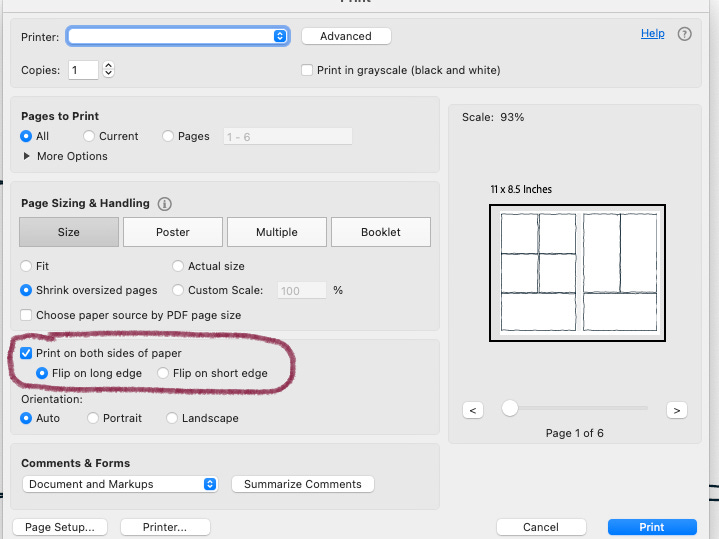
Except everything was upside down the pages on the backside. So first page is the front side, the backside for the double print. Page two, right? That second page, all upside down. Printer settings. Who knew, right? So I said, alright, instead of trying to figure out my printer settings and then screwing up every other printer setting that I have for doing this, I'll just flip the templates.
So instead of doing that, what I did is I flipped the, instead of the, you can hear me trying to figure out how to say it, what would be on the right hand side for if you were thinking of it just visually on the right hand side, it needed to actually be on the left hand side because the printer settings were printing everything upside down and backwards because why wouldn't it makes perfect sense upside down and backwards. So basically I flipped everything upside down and made it backwards on the template in order for it to print out correctly on my printer.
So after, again, a brain melting time of going, this can't possibly work. This looks stupid, you're an idiot. You shouldn't even be trying this. I said, screw it. I'm going to print out one more version. Printed out that version.
I opened it and magically I say everything was the way I wanted it. I had my plot section where I've got the three boxes here, facing, beginning, middle, and end actually facing each other in the correct order. I've got my feeling wheel right against the character it's facing the character and all the details that we have with that where I can have the character photo. I've got blank pages, I've got this, it f-n’ worked. F-n’ worked.
It's really excited, super excited. So that is what I came up with.
And then as I was thinking through, alright, I've got this box on the front where it's for the character name. The only other tidbit that I have for you is I initially just wrote the character's name in small letters, right? I'm like, great, this is Adie. And I looked at it and I said, the last thing I want to do is pick up this character booklet with such a measly, tiny little name in this giant box. I'm like, this needs to be big and bold and exciting. So what I'm doing is I'm writing their names big and bold in this box, and then I'm going to doodle around the little things that I need to remember about the different characters. So we've got Adie, she's pretty blank right now. I've got ideas for her, but she's a little bit more complex. But we'll take Kit for example, we're going to most definitely have some sort of plumbing connectors because the K is just perfect for plumbing connectors.
But then we're going to have some old books in there. How am I going to doodle old books? I don't know. I'll probably put a spider on there. She's going to have snakes on here. She's going to have that. But it's going to make the booklet come alive.
And then each character, rather than being in one big book, because I forgot to say, trying to do all of this spatial mapping and page layout so that it's four different characters all in the same book. No, can I just say no? My brain was so tired and so melted. Screw it. Each character gets their own booklet. So with each character getting their own booklet, then I can pick up the booklet and then we've got their names, doodles about things that are important to them, things I want to remember, things that help evoke that individual for me.
And then I can look through and I can say, ah, hey, what's happening with this character? And as new phrases come up like Kit’s Grandma’s sayings; Grandma's going to have a hell of a lot more sayings. Well, great, I got pages and places where I can keep track of Kit’s Grandma’s sayings as I think of them, maybe they'd make it into the story, maybe they don't. But Grandma's going to have sayings and I need a place to remind myself for those. And that tactile element of it makes the characters come alive. This is Kit's booklet. This is all about Kit. It's not some column in row on a spreadsheet. It's not some page that's sitting off to the side on a, whether it's in Scrivener or whether it's in Word or whether it's fill in the blank, whatever tool it is.
This is a living, breathing document because it's a living breathing document. It's a booklet of a character. Alright?
So whether or not you were interested in the full story of how the hell I arrived at the character booklet, that is fine. You could have skipped this whole darn thing. And I still would be absolutely thrilled if you downloaded and were able to use the character booklet template.
I've included instructions in here so that you can take a look at how to use it. I'll include printer instructions in this post as well. So you can kind of see what my settings were, match your settings in case your printer works differently than mine because they all work differently.
And then let me know what you think of it and then I will continue to post and show as I've got the things sketched out.
Hey, I hope you have a wonderful day. Thank you for listening. Thank you for letting me share my character booklet creation story.
And thank you for working with me and not quite thinking, ‘This is easy. She should have figured this out within minutes.’ Uhuh, my brain works at my own brain's pace and I am really proud and really thrilled and giving my brain a high five for figuring this out and figuring out a path so that the characters can come alive for me.
Character Booklet Template

Recommended printer settings
How to fold the pages when they come out of the printer.
You are going to want to organize them because they’ll look wrong; fight the urge. This is how it works.